Showing posts with label diy: how to help bees. Show all posts

Tuesday, February 23, 2010

Rare bee rediscovered in Scotland after 50 years

southern cuckoo bumblebee photo Bombus vestalis, better known as the Southern Cuckoo bumblebee. Image credit: Wikimedia Commons It's been absent from the hives of Scotland for 50 years but, it seems, the Southern Cuckoo bumblebee has returned. Still common in England, the curi...Read the full story on TreeHugger

Wednesday, January 13, 2010

"The Honey Song" from The Secret Life of Bees by Sue Monk Kidd


place a beehive on my grave
and let the honey soak through.
when i'm dead and gone,
that's what i want from you.

the streets of heaven are gold and sunny,
but i'll stick with my plot and a pot of honey.
place a beehive on my grave
and let the honey soak through.

Saturday, October 3, 2009

6 Facts About Native Bees

6 Facts About Native Bees
How to raise one of North America's native pollinators, the orchard mason bee. (Hint: If you have a drill, you can be a beekeeper.)
Simple holes drilled in wood provide homes for native orchard mason bees.
9.30.2009 Link to full article below

Denise Shreeve is a beekeeper of an unusual sort. Instead of honey bees at her home in McLean, Va., she raises native orchard mason bees -- solitary bees that don't produce honey, but do pollinate abundant gardens and crops. Shreeve also designs bee houses -- including some made from antiques -- so backyard beekeepers and gardeners can take advantage of these amazing native pollinators. "I find antique artifacts like this corbel, and drill holes in them for our native bees to nest in," she writes. "They become beautiful yard sculptures that recycle beautiful artifacts and provide nesting sites for our native bees. Does it get any better than that?" Here's her quick primer on native bees:

Orchard mason bees are native to the entire North American continent and are amazingly efficient pollinators, especially of early fruit and nut trees. (It takes only 250 OMB's to pollinate one acre of commercial apple orchards. It would take 25,000 honey bees to accomplish the same task.) After completing a honey beekeeping course a few years ago, and realizing how many chemicals it takes to keep them alive, I decided to research native bees as an alternative. It's been a fascinating project and I know that our native bees (there are over 20,000 different species in North America alone) can certainly take up the slack as our honey bee populations decline. Since they are cavity nesters like blue birds, and cannot drill their own nesting holes, I decided to help grow their populations by designing bee houses for them, similar to blue bird trails that are so popular now.

I could go on and on about these fascinating little insects, but here are a few facts you might find interesting:
orchard mason bee antique house

* Orchard Mason Bees (aka: OMB’s, Mason Bees, Blue Orchard Bees or BOB's) are gentle, mild-mannered solitary bees that rarely, if ever, sting. (Males don't even have stingers.)
* They are not affected by the parasitic mites that are killing the honey bees.
* OMB’s do not make honey, but rather use collected nectar and pollen to feed themselves and their young.
* They don’t have a Queen to defend so will never attack if disturbed, making them very safe around kids and pets, and fun and educational to watch.
* They’re a bit smaller and rounder than a honey bee, and have a beautiful blue-green metallic shine in the sun.
* They are native to North America, unlike honey bees which were brought over from England in the 1630s. This makes OMB's well-adapted to pollinate our plants.

To read the full article: http://www.thedailygreen.com/environmental-news/latest/native-bees-47093002?src=nl&mag=tdg&list=dgr

Sunday, April 12, 2009

Thursday, January 29, 2009

UK Chain Bans 8 Pesticides That Have Killed Billions of Bees Worldwide (AND WE NEED TO DO THE SAME THING!!!!)

Co-op bans eight pesticides after worldwide beehive collapse

First UK supermarket chain – and Britain's biggest farmer – to prohibit chemicals implicated in the death of over one-third of British bees

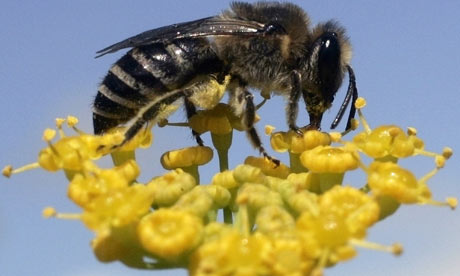
A bee collects nectar from a flower in a garden in Pontevedra

A bee collects nectar from a flower in a garden in Pontevedra. Photograph: Miguel Vidal/Reuters

The Co-op today became the first UK supermarket to ban the use of a group of pesticides implicated in billions of honeybee deaths worldwide.

It is prohibiting suppliers of its own-brand fresh produce from using eight pesticides that have been connected to honeybee colony collapse disorder and are already restricted in some parts of Europe.

The Co-op said it will eliminate the usage of the neonicotinoid family of chemicals where possible and until they are shown to be safe. The Co-op has over 70,000 acres of land under cultivation in England and Scotland, making it the largest farmer in the UK. Since 2001, it has already prohibited the use of 98 pesticides under its pesticide policy.

Simon Press, senior technical manager at the Co-op group said: "We believe that the recent losses in bee populations need definitive action, and as a result are temporarily prohibiting the eight neonicotinoid pesticides until we have evidence that refutes their involvement in the decline."

Laboratory tests suggest that one of the banned chemicals, imidacloprid, can impede honeybees' sophisticated communication and navigation systems. It has been banned in France for a decade as a seed dressing on sunflowers. Italy, Slovenia and Germany banned neonicotinoids last year after the loss of millions of honeybees. And the European Parliament voted earlier this month for tougher controls on bee-toxic chemicals.

Paul Monaghan, the Co-op's head of social goals accused the UK government of failing to recognise that "pesticides could be a contributing factor" in the breakdown of nature's number one pollinating machine.

Elliott Carnell, coordinator of Pesticide Action Network (Pan) Europe, said he hoped the Co-op's pioneering stance would persuade the UK government to back the proposed European legislation. "The government has fought against any attempts to protect bees, which pollinate a third of the average diet. It argues that banning pesticides jeopardises crop yields, but if that was the case why would a leading food retailer be introducing this measure?"

The pesticide ban is part of the Co-op's 10-point Plan Bee launched today, which includes £150,000 for research into the impact of pesticides on the decline of honeybees in England, where more than a third of hives were wiped out last year. It will also give away bee-friendly wildflower seeds to Co-op members and customers.

Monday, October 20, 2008

Be Kind to Bees

The buzz: Be kind to bees

Source: http://www.strausnews.com/articles/2008/10/17/the_chronicle/news/4.txt


Local farmers find that TLC and good bee hygiene boosts crop yields

By Edie Johnson

Chester — In this season of abundance, we are fortunate to live among farmers who keep our tables well supplied with fresh fruits and vegetables right through to Thanksgiving. But let us not forget to thank other hard workers on our behalf: those busy pollinators, the bees. Without them, farmers would find nothing in their fields to harvest.

But bees are in danger because of a recent phenomenon called colony collapse disorder, which has dwindled their numbers and threatened a good portion of our food sources. But some local hives, and innovative treatments, may help. This year, hives had to be shipped in from the South to help farmers in Chester and Blooming Grove, and so far they are doing fine.


When not busy at his regular “city job,” Ken Steger raises goats and tends beehives at his Chester home. He bought some imported hives this year along with Guy Jones of Blooming Hill Organic Farm on Route 208 (www.bloominghillfarm.com), which produces organic vegetables for many posh New York City restaurants and markets. He also farms land in Chester’s famous black dirt area and runs a fascinating co-op farm in the mucklands by Otterkill Road under the trestle in Mountainville (pictured below). Jones offers a wide variety of herbs, fruits, vegetables, organic granolas, a secret recipe mint ice tea, and organic farming information (see links on his Web site), and crafts. His farm has been active for over 20 years and is featured in epicurean magazines. Many consider him the local guru of organic and cooperative farming.

Hives from the South were shipped to Jones’ farm before. But 15 years ago, and then twice again last year, a couple of what are known locally as the “Oxford Road Bears” destroyed the hives. Steger and Jones have since moved the hives to the black dirt site, which bears apparently do not like as much.

Foot baths for bees


Steger said local bees are healthy because of the special care and immaculate conditions they enjoy here. His bees are washed daily — not the bees themselves, but the storage frames they live in. It’s called a “foot bath” because the solution used at the entrance of the hive to clean the frames keeps the bees from spreading germs. His bees are also fed a sugar syrup to keep them well-nourished when they do not find nectar in flowers.

Steger attributes the bee crisis across the country to a weakened immune system. Some of the immunity-fortifying species that bees feed on have been nearly eradicated, he explained. And the conditions are unhealthy in some commercial hives, which are often overcrowded and don’t even allow the bees to develop honeycombs.

Jones said he’s seen a significant increase in the yield of his crops because of the bees. One of the more unusual crops grown at Blooming Hill Farm is buckwheat, which Steger uses to make his distinctive honey.

Blooming Hill is not the only farm to benefit from this bee project. Most bees travel six to eight miles in their search for nectar, so they expect other large farms, particularly in Chester, such as Pine Hill Farm and Roe’s Orchards on Route 94, to benefit too.

And these benefits extend beyond crops. As their business grows, local farms are branching out. Pine Hill sells pottery, and Roe’s offers a wide variety of homemade jams in addition to their famous cider.


The threat of sprawl

Some speculate that the bees’ problems are due to urban sprawl. As developers clear ground for new houses, hedgerows and other nectar-gathering grounds are bulldozed. What the bulldozers don’t remove is clipped short by the new homeowner or poisoned with weed killers.

Bees have a very complex social structure that requires a joint effort to develop the myriad combs that make a healthy hive. Limit their choice of flowers, and the bees may be deprived of nectars important to a healthy immune system.

Local planning boards are helping by asking developers to retain hedgerows and buffer lands. There are many benefits to these natural buffers. One of them is providing places where bees can gather nectar.


Recent developments that give hope to farmers include better urban planning, less use of pesticides, and improved organic farming techniques. The average homeowner can help too, by planting a few fruit trees in the yard.

When they swarm in every spring, the bees sip first from dandelions, clover, forsythia, and lilacs. Then they switch to the annual and perennial flowers that brighten our gardens. They proceed finally to our crops, especially cucumbers, squash, grapes, pumpkins, and corn.

With every bite, we can thank the bees for our plenty. Steger and Jones will do their part to make sure they stay happy, healthy, and, as we naturally expect from bees, busy.

Photo by Edie Johnson


Boom and bust

In ancient times, the Pharisees would send bee hives downriver to help establish a new farming community. In more recent times, our own pioneers brought hives from Europe, taking them along as they traveled South and West because they knew they were crucial for a full harvest. Farmers in the 19th century started to build large storage frames that allowed commercial pollination to develop.

Beekeeping has become a big business in the United States. About 1,000 breeders transport bees across the country in huge commercial vans. Commercial breeders winter the bees over in areas of the South so they will be primed to do their work early in the spring. Some farming activities, such as the almond tree groves in California, would be devastated without them.

As recently as the 1940s, the United States boasted 5 million healthy bee colonies. Today, this number has dwindled to about 2.3 million. Experts find diseased and sometimes completely empty hives, and have still not been able to determine where the bees have gone. Sometimes bees will make their hives underground.


These experts say the causes of colony collapse are complex, and that the disorder is not due to one factor alone. But one of the main culprits is a small brown mite, similar to a tick, that came from Asia. In past years beekeepers had antibiotics to keep parasites under control, but they have now developed resistance to the medicine and in recent years bees have been disappearing by the millions.

About bees

Bees include four broad categories that help pollinate crops. About 4,500 species of bees are native to the United States and Canada.

Bees are tended both by small local beekeepers and large commercial breeders. Natural varieties live in the remaining hedgerows and forests. In recent years, bees have been imported from Italy, Russia, Great Britain, Australia, and New Zealand. Some of the natural varieties that thrive along local hedgerows seem to have developed hardier strains, and some of the imported bees seem to be resistant to colony collapse disorder. On the other hand, bees imported from Australia are suspected to have brought the current virus in the first place.

Every variety has its own characteristics. Some are friendly, others aggressive and likely to sting. Some are productive, others less so.

Bees produce different flavors of honey, depending on the kinds of nectar they thrive on.

While a queen bee may live several years, worker bees die after they build their hive and bring in the nectar.

Tuesday, October 7, 2008

How to help save the honeybees

Oct. 6, 2008 | Dear Pablo,

I am still haunted by colony collapse disorder (CCD). I know the scientists are studying it, but is there anything that I and other individuals can do to help the bees?

The mysterious disappearance of honeybees in North America has been truly disturbing. According to some sources, over 40 percent of honeybee colonies have vanished each year since 2006 (30 to 90 percent according to the United States Department of Agriculture). While no one knows for sure what is causing this alarming trend, there are several theories, as well as some steps that you can take to help protect the bees yourself.

Besides converting nectar into deliciously sweet honey and making wax that we can use in candles, bees serve a much more important purpose: pollination. Bees pollinate about one-third of the crops we eat, including grains, nut trees, fruit trees and even watermelon. The pollination of crops is an ecosystem service that has intangible value. When you add up all of the ecosystem services that we enjoy, such as a stable climate, a supply of fresh water from rain, and a source of cellulose from trees and other plants, the collective value of our natural ecosystems is said to equal the "Gross World Product." Similar to the GDP measure of the U.S. economy, the GWP represents the value of the world economy. Recognizing that our economy is wholly dependent on the ecosystem services of this planet puts the importance of environmentalism into perspective.

Consider for a moment the Biosphere 2 project in the Arizona desert. The fully sealed structure housed several scientists for long periods of time to see if a self-sustaining ecosystem could be maintained. The project cost $200 million but was unable to provide sufficient food for the scientists and several outside injections of pure oxygen were required. Now consider the value provided by bees and other pollinators. Imagine if they were to disappear completely and humans had to manually pollinate crops all around the world. Not only would the cost be prohibitively expensive, but non-food plants would remain unpollinated and become extinct. So you can see how important bees are to our economy and how important it is to save them.

CCD doesn't simply mean the complete death or disappearance of a hive. The USDA says that "the main symptom of CCD is simply no or a low number of adult honey bees present but with a live queen and no dead honey bees in the hive." According to the USDA, "A perfect storm of existing stresses may have unexpectedly weakened colonies leading to collapse." These stresses include pesticides, a pathogenic gut microbe called Nosema, and the frequent relocation of hives as the beekeepers migrate with the crops. Most recently, researchers are examining a virus called Israeli acute paralysis. Climate change has not been ruled out as a possible cause, or at least contributor to CCD. A gradually warming climate allows parasites, competitors and predators to move north because of less severe winters or the absence of a heavy frost where it was once common.

So what can we do to support the struggling honeybees and to avoid the disastrous effects of their complete disappearance? The USDA suggests that "the best action you can take to benefit honey bees is to not use pesticides indiscriminately, especially not to use pesticides at mid-day when honey bees are most likely to be out foraging for nectar." You can also plant native plants in your garden that require minimal watering, don't require the use of pesticides and that provide food for bees. These plants include red clover, foxglove, bee balm and Joe Pye weed.

In a stirring new book, "Fruitless Fall," author Rowan Jacobsen presents several tips on creating a bee-friendly habitat in your backyard. If you want to try your hand at backyard apiculture (beekeeping), he recommends getting a kit from Betterbee. But if you don't want the responsibility or don't want to make this investment, you can at least make your landscaping into a bee buffet. Start by avoiding flowering plants that were bred for showy features, such as sunflowers or tulips. Instead focus on a wide variety of native plants that blossom in succession, rather than one plant that blooms all at once. This provides a more constant supply of reliable food for the bees. Also keep in mind that good housing is hard to find for bees, so consider providing some options such as a specially designed bee house (check your local wild bird store or garden supply) or a bare patch for bees that prefer nesting in burrows.

In addition, support your local beekeepers by buying locally produced honey at a farmer's market or natural foods store near you. This will help keep the important profession of beekeeping financially viable. Finally, you may want to support businesses that are actively creating awareness of CCD, such as Häagen-Dazs and Burt's Bees, which makes personal care products using beeswax, supports the Honeybee Health Improvement Project, and sent out 50,000 packets of wildflower seeds to individuals for signing up on its Web site.

Related Posts with Thumbnails