Showing posts with label healthy: locally grown. Show all posts

Saturday, December 4, 2010

Why it is important to grow or buy - and eat - locally grown food!

Why it is important to grow or buy - and eat - locally grown food!

I couldn't find labels on all of my produce, but let's take a look at what I did find. Here's a list of fresh (and I use that term loosely) produce I ate for breakfast and lunch, where it originated from, and the number of miles it traveled to get to me. It should be noted that the mileage I list is direct from point A to point B. In all likelihood, my produce traveled considerably farther before gracing my table.

Bananas – Ecuador – 2,886 miles
Blueberries – Chile – 5,177 miles
Apples – Washington – 2,024 miles
Oranges – Florida – 817 miles
Avocado – Florida – 817 miles
Kale – California – 2,088 miles
Collards – California – 2,088 miles
Cucumbers – Mexico – 1,917 miles
Tomatoes – Florida – 817 miles
Peppers – Mexico – 1,917 miles
Onion – Washington – 2,024 miles

So by the time I had finished lunch, my food had traveled 22,572 miles. That's almost one full trip around the globe! Anyone else see the absurdity in this?


Saturday, November 13, 2010

Support local growers! Here's a few reasons why...


* The average meal in the US travels 1500 miles before reaching your plate.
* Frozen peas requier 150% more energy than fresh peas due to packaging and refrigeration.
* A head of lettuce traveling from CA to NC uses 36 times more fossil fuel energy in transport than it provides in food energy.
* Farmers selling produce locally can grow varieties chosen for taste instead of varieties chosen for how well they travel.
* Farmers' markets enable growers to keep 80 cents to 90 cents per dollar spent by the consumer compared to 9 cents in traditional food markets.
* Produce not sold locally is often in transit or cold storage for days or weeks, and its nutritional value declines with time.
* When you purchase locally grown produce, your money stays within your community.

Thursday, July 8, 2010

12 Reasons for Visiting a Farmers' Market


12 Reasons for Visiting a Farmers' Market
by Alice Henneman, MS, RD

http://lancaster.unl.edu/food/ft-jul-10.shtml

Whether you've never visited a farmers' market, are a frequent visitor or just enjoy the fresh taste of local foods, this month's Food Reflection's offers a little something for everyone:

1. Start by reading the following short article on "12 Reasons for Visiting a Farmers' Market."
2. Download a copy of the article. Use it for a bulletin board or handout ... add information about farmers' markets in your area.
3. Enjoy a short 1-minute video showing several pictures left out of the article.
4. Download a short, related PowerPoint, "12 Reasons for Visiting a Farmers' Market." Include some or all of these reasons for attending a farmers' market in a presentation you're giving!
5. Access a link to several recipes for fresh produce -- many also can be used as program handouts or at farmers' markets.
6. Obtain more information on shopping at farmers' markets and download a free PowerPoint, "The Garden Grocery: Food Safety & Selection at the Farmers' Market."

To begin ... here are 12 great reasons to visit a farmers' market.

1. Find foods not available in a grocery store.tomato bruschetta

2. Take home a truly tasty tomato! Make a tomato, basil, and olive oil bruschetta or other recipe!

3. Enjoy really fresh sweet corn. Fresh from the field means fantastic flavor!

4. Purchase a pretty plant you know will grow in your state because it was locally grown in your state.

5. Meet with a master gardener. Extension master gardeners are available at some of the Farmers' Markets. They'll answer your garden questions and help make your garden grow!

purple cauliflower meal6. Make memorable meals. The meal at right features toasted sunflower wheat bread with lettuce and smoked bacon cheese; kale sauteed in olive oil with green onions and garlic; purple (graffiti) cauliflower ... all from one Farmers' Market!

7. Have fun with your family and friends. Many Farmers' Markets feature special events, such as cooking demonstrations, music, festivals, and more.

8. Get really fresh food that didn't travel long distances to reach you. Freshly picked produce not only tastes better, but keeps longer, too! Look for the Buy Fresh Buy Local sign used many places to identify locally grown produce.

9. Buy a beautiful bouquet of locally grown flowers.
strange squash

10. Get to know your farmer. Ask questions about how the food was grown, how to cook it, and more.

11. Support your local economy. If every household spent $10 every week on locally-produced food, think how much could stay in your local economy each week.

12. Farmers' Markets are full of surprises -- you never know what you might see!


Monday, January 4, 2010

Seasonal Produce - Eat According To Earth's Local Harvests

Winter

Spring

Summer

Autumn/Fall

Beetroot Purple Sprouting Broccoli Asparagus Wild mushrooms
Cabbage Carrots Courgettes (Zucchini) Sweetcorn
Leeks Spring onions (Scallions) Mange Tout Beetroot
Onions New potatoes Globe Artichokes Sweetcorn
Brussels Sprouts Spring greens Garden Peas Cauliflowers
Shallots Lettuces Green beans Carrots
Parsnips Asparagus Cucumber Marrows
Swede Broad beans Lettuces Broccoli
Spinach Spinach Radishes Butternut squash
Curly Kale Rhubarb Watercress Turnips
Artichokes
Peppers Cabbages
Pumpkin
Tomatoes Parsnips
Apples
Sweetcorn Celery
Pears
Summer berries Leeks
Nuts
Cherries Apples


Currants Pears


Plums Almonds


Melons Chestnuts


Apricots Elderberries


Grapes


Figs

Thursday, July 2, 2009

There's No Such Thing as Local vs. Organic Food

There's No Such Thing as Local vs. Organic Food
by Timothy J. LaSalle
Rodale Institue, Kutztown, PA
06.24.09
link to full article below

Let’s clear up one issue: There is no such thing as local vs. organic. When it comes to consumer choice, we should be buying local and organic, though for mostly different reasons.

Why We Should Buy Local
Local is really important as a deep investment into your local economy and developing a relationship with the person who produces your food. Not only do local businesses generate more local income, jobs, and tax receipts, but they also tend to utilize advertizing, banks, and services in the local community. In fact, a dollar spent at a local business turns over seven times in that community; while the same dollar spent at a box store or chain only turns over 2.5 times. Buying locally builds a healthy community on many levels. (For case studies on the economic, social, and environmental impacts of buying local visit the Business Alliance for Local Living Economies). Not only can you support the economic health of your community and offer security to your hardworking neighbors, but you can eliminate the uncertainties of agribusiness by talking to your farmer and seeing first-hand how your food is produced. It is also helpful in being able to purchase food
that is often fresher. What’s more is buying local can create local food security, which may become more and more important in the near future. We at Rodale Institute couldn’t be more enthusiastic about local.

Considering the Carbon Footprint of Food
In this conversation, food carbon footprint often arises. However, the most carbon intensive portion of food production and consumption, outside of driving to the store and putting the food in your refrigerator, is the farming methods. The amount of carbon dioxide that is released into the atmosphere varies widely with regard to the manner in which the food is grown. Because the manufacture of chemical fertilizers and other conventional farming inputs are reliant upon vast amounts of fossil fuel, the food you eat (local or not) can account for huge levels of carbon dioxide (CO2) releases. According to a recent New York Times article about Tropicana orange juice, fertilizers alone contribute to nearly 60% of the CO2 emitted in production. Conventional chemical-based agriculture is a net emitter of CO2 and by some estimates contributes between 9 – 20% of our total greenhouse gases in the U.S.

On the other hand, non-chemical organic farming will pull carbon dioxide right out of the atmosphere and hold it in the soil for decades. As a matter of fact, research at Rodale Institute that has now been replicated at several land grant universities, shows that over 3.5 tons of CO2 can be sequestered on well-managed organic soils using compost and no chemical inputs. Synthetic fertilizers and many pesticides used in conventional farming inhibit the biological factors that build soil carbon, which adds to the long-term destruction of soils.

Why We Should Buy Organic
If we converted all tillable acres globally to organic practices, we could sequester up to 40% of all the world’s carbon emissions. This is the single largest strategy for mitigating carbon dioxide.

To read the full article: http://www.treehugger.com/files/2009/06/there-is-no-such-thing-as-local-vs-organic-food.php?dcitc=weekly_nl

Thursday, May 14, 2009

When ‘Local’ Makes It Big

When ‘Local’ Makes It Big
By KIM SEVERSON
May 13, 2009

http://www.nytimes.com/2009/05/13/dining/13local.html?pagewanted=print

WHEN Jessica Prentice, a food writer in the San Francisco Bay area, invented the term “locavore,” she didn’t have Lay’s potato chips in mind.

But never mind. On Tuesday, five potato farmers rang the bell of the New York Stock Exchange, kicking off a marketing campaign that is trying to position the nation’s best-selling brand of potato chips as local food.

Five different ads will highlight farmers who grow some of the two billion pounds of starchy chipping potatoes the Frito-Lay company uses each year. One is Steve Singleton, who tends 800 acres in Hastings, Fla.

“We grow potatoes in Florida, and Lays makes potato chips in Florida,” he says in the ad. “It’s a pretty good fit.”

Mr. Singleton’s ad and the other four will be shown only in the farmer’s home state. A national spot featuring all five potato farmers begins next week.

Frito-Lay is one of several big companies that, along with some large-scale farming concerns, are embracing a broad interpretation of what eating locally means. This mission creep has the original locavores choking on their yerba mate. But food executives who measure marketing budgets in the millions say they are mining the concept because consumers care more than ever about where their food comes from.

“Local for us has two appeals,” said Aurora Gonzalez, director of public relations for Frito-Lay North America, which is owned by PepsiCo. “We are interested in quality and quickness because we want consumers to get the freshest product possible, but we have a fairly significant sustainability program, and local is part of that. We want to do business more efficiently, but do it in a more environmentally conscious way.”

To read the full article:
http://www.nytimes.com/2009/05/13/dining/13local.html?pagewanted=print

Thursday, April 2, 2009

Community-supported food suppliers on the rise

Community-supported food suppliers on the rise
March 31, 2009

Million-dollar homes are a stone’s throw away from Meyer’s Farm in Woodbury, Long Island. More produce growers used to cultivate nearby lands in what has become a tony suburb, but the Meyer family kept a swath of acreage and plies the community with corn, pumpkins, house plants and other earthly products year-round.

Their special bond with customers is a win-win. They keep their profession alive, and customers buy from a trusted, local source they feel good about supporting. They know their food is local and has a low carbon footprint. Other farmers a few miles away draw repeat customers and passersby to their roadside tables and vans for fresh pies, ciders and vegetables.

Meyer’s is a private enterprise, not a community-funded cooperative where people pay a fee and share set amounts of harvests. However, its relationship with the community it serves symbolizes a dynamic that repeats itself in countless pockets across the nation, and creates a vast American food network outside of supermarkets and other retailers. The appeals are food freshness, quality, value, confidence in local resources, and a unifying togetherness.

Actual cooperatives are growing at a time when people feel unsettled by economic turmoil, and want to reconnect with some grounded elements in life.

To read the full article:
http://supermarketguru-com.advantex.net/index.cfm/go/sg.viewArticle/articleId/376

Thursday, March 19, 2009

Success in Brazil: The City That Ended Hunger Did It By GOING LOCAL

Success in Brazil
The City that Ended Hunger did it by going local
by Tom Laskawy
16 Mar 2009

http://gristmill.grist.org/print/2009/3/16/114116/636?show_comments=no
http://gristmill.grist.org/story/2009/3/16/114116/636

What struck me in Frances Moore Lappé's piece at Yes! on Belo Horizonte, Brazil -- the city that ended hunger -- was how simple the solution was:

[The city] offered local family farmers dozens of choice spots of public space on which to sell to urban consumers, essentially redistributing retailer mark-ups on produce -- which often reached 100 percent -- to consumers and the farmers. Farmers' profits grew, since there was no wholesaler taking a cut. And poor people got access to fresh, healthy food.

In addition to the farmer-run stands, the city makes good food available by offering entrepreneurs the opportunity to bid on the right to use well-trafficked plots of city land for "ABC" markets, from the Portuguese acronym for "food at low prices." Today there are 34 such markets where the city determines a set price -- about two-thirds of the market price -- of about twenty healthy items, mostly from in-state farmers and chosen by store-owners. Everything else they can sell at the market price.

[The city started] three large, airy "People's Restaurants" (Restaurante Popular), plus a few smaller venues, that daily serve 12,000 or more people using mostly locally grown food for the equivalent of less than 50 cents a meal.

Belo's food security initiatives also include extensive community and school gardens as well as nutrition classes. Plus, money the federal government contributes toward school lunches, once spent on processed, corporate food, now buys whole food mostly from local growers.

If those policies sound familiar, it's because they echo common recommendations among US food policy progressives, as well as those in Manhattan Borough President Scott Stringer's report on localizing the NYC foodshed. But it's always nice when someone tries them out first -- and they work. And work they did:

In just a decade Belo Horizonte cut its infant death rate -- widely used as evidence of hunger -- by more than half, and today these initiatives benefit almost 40 percent of the city's 2.5 million population. One six-month period in 1999 saw infant malnutrition in a sample group reduced by 50 percent. And between 1993 and 2002 Belo Horizonte was the only locality in which consumption of fruits and vegetables went up.

And the cost? $10 million for a city of 2.5 million. Granted, that figure isn't adjusted for US purchasing power -- but it represented a mere 2 percent of the city budget (and Belo probably has a much smaller/simpler budget than NYC). Also, note the focus on school lunches (sound familiar?) and the way the city directly subsidized purchases of fruit and vegetables.

Granted, Belo's efforts focus on malnutrition, while we in the developed world must attack the two-headed monster of hunger AND obesity. On the other hand, Belo's policies would likely conquer both. Still, this Brazilian city provides hard evidence that you can address underlying social ills when you localize urban food systems and promote healthy eating. That is very good news indeed.

Friday, January 30, 2009

Why Local, Sustainable Agriculture?

Why local, sustainable agriculture?

  • Did you know that 17 % of petroleum demand in the US is for the food production industry? (http://www.energybulletin.net/5173.html)
  • Did you know that the food on your plate has traveled an average of 1500 miles to get there? (Barker & Mander, 1999, Invisible Government: The WTO Global Government for the New Millenium)
  • Did you know that the average age of a farmer in Colorado is 55?(“Losing Ground - Colorado’s Vanishing Agricultural Landscape)
  • Did you know that between 1997 - 2002 Colorado lost an average of 690 acres of prime agricultural land per day to residential development? (“Losing Ground - Colorado’s Vanishing Agricultural Landscape)
  • Did you know smaller farms tend to be 2-10 times more productive than larger farms? (http://www.energybulletin.net/5173.html)
  • Did you know that 90% of the agricultural subsidies benefit corporations and big farmers growing food for export; while 500 family farms close down every week in the United States? (http://www.energybulletin.net/5173.html)
  • Did you know that 91 cents of each dollar spent at traditional food markets [ie: commercial] goes to suppliers, processors, middlemen, and marketers; only 9 cents of each dollar actually goes to the farmer? (Smith, Stewart. 1992. “Farming Activities and Family Farms: Getting the Concepts Right.” Presented to the US Congress Symposium, “Agricultural Industrialization and Family Farms: The Role of Federal Policy.”)

What is sustainable agriculture?

Sustainable agriculture is a way of raising food that is healthy for consumers, preserves agricultural land, provides a fair wage to the farmer, supports and enhances rural communities, does not harm the environment and respects animals.

Some principles of sustainable practices include:

  • Reducing off-farm inputs including petroleum based synthetic chemicals
  • Managing instead of controlling pests and weeds
  • Reestablishing natural biological relationships with the farm setting
  • Farming within the physical limitations of the farm
  • Using plant and animal species that are adapted to the environment of the farm
  • Conserving soil, water, energy, and biological resources
  • Integrating the idea of long term sustainability into the design of the system

Thursday, October 30, 2008

Farm To School Programs Grow Students' Appreciation for Locally Grown Food

Farm-To-School Programs Grow Students' Appreciation for Locally Grown Food

* By Diane Raymond
Natural News, October 20, 2008

Source: http://www.organicconsumers.org/articles/article_15243.cfm

As farmers struggle to mitigate the increasing cost of transporting produce from farm to store and schools face smaller budgets and increasing concerns over the nutritional content of school lunches, some schools opt to bring the farm to the lunch table.

The concern over the nutritional value of school lunches isn't unwarranted: 15% of children ages 6-19 are considered overweight, according to a recent study conducted by CDC epidemiologist Cynthia Ogden, PhD. Between pre-packaged, highly processed lunches and vending machines loaded with sugary snacks and sodas, it is little wonder parents also worry about fueling their kids' minds. Many are asking the schools to do more, pointing out that the National School Lunch Program isn't passing muster.

Nearly half of the children in the U.S. who attend private and public schools participate in the NSLP, a federally assisted meal program that dates back to 1946. While the NSLP does provide a low-cost (and in some cases, free) means of delivering lunch through subsidies to schools, the program has been widely criticized in recent years for contributing to America's obesity epidemic. According to the Sustainable Table, a non-profit organization dedicated to educating the public about the problems with our food supply, our children are not meeting the RDA of vitamins and nutrients under the current NSLP guidelines. Couple that with the skyrocketing price of food, which extends beyond the family table to the school cafeterias as well. Forced to consider lower-priced alternatives to fresh foods, many schools have no alternative but to rely on the cheaper, less healthy fare. A number of districts across the country are taking matters into their own hands and breaking the mold. Instead of doling out sodium and fat-laden chicken nuggets for lunch, they are opting to assist local farmers and provide healthier, locally grown foods to students.

Eating and Learning: Models of Success

In the small community of Glen Lake, Michigan the farm-to-school program gives local schools an opportunity to sample tasty, healthy meals grown with as many locally grown products as possible. Not only is this a great opportunity for the children to develop an appreciation for locally grown food, studies show that children who are fed healthier, more nutrient rich foods are better learners. Michigan's program is a prime example of how school districts can assist local growers and simultaneously teach students about the health and economic benefits of consuming local produce.

Schools in Berkeley, California, have become a national model for how to make schools more sustainable. The Edible Schoolyard Project at Martin Luther King Jr. Middle School takes the farm-to-school concept one step further: the students use their school's organic garden as a learning tool. Students learn about planting and harvesting, cooking and eating, and biology, ecology, nutrition and sustainability. This program has become so successful that many schools around the country now have their own gardens. The National Gardening Association (http://www.kidsgardening.org/School/sea...) has a list of thousands of school gardens nationwide.

Students at the Louisa May Alcott elementary school in Chicago's Lincoln Park neighborhood savor daily lunches dished up by local chef, Greg Christian. Christian runs the nonprofit Organic School Project, through which he donates half of his time and salary to a grand mission: seeing that Chicago students eat better. Nearby schools will be added to the OLP, with further plans to build teaching gardens at each school.

There is more good news: The National Farm to School program, a national network of community-based food systems that assist farmers and improve student health, estimates that more than 2,000 Farm to School Programs are currently underway in the U.S., with more than 8,700 schools actively participating.

HOW TO START A FARM TO SCHOOL PROGRAM
(from The National Farm to School Program website)

1. Research: Read the publication Going Local to acquaint yourself with model farm to school programs from across the country. As Farm to School programs come in many shapes and sizes, it's important to begin to identify what you want and what would work best in your school. Visit www.farmtoschool.org to learn if there is a program in your area.

2. Organize: Coordinate a group of cross-sector stakeholders in the community for a meeting to discuss farm to school (food service directors, parents, teachers, farmers, students, school administration, local nonprofits, etc.) Inspire potential supporters with an activity such as a farm tour or a farm-fresh taste test.

3. Assess: Facilitate conversations with various stakeholders to determine the feasibility of the program in your area—discuss where to buy local foods, assess how to serve them at school, identify staff or volunteers to support the program, and determine what the budget for your program can be.

4. Plan: Create a short description of your ideal program and then list specific first steps. Tip: start with easy wins! Try to limit this to five steps to help you organize and communicate your goals to others.

5. Start: Take small steps such as working with one or two whole products that are easy to process and popular among kids. Local apples, oranges, or strawberries are a good choice when they are in season.

What are you waiting for? Plant the seeds of farm to school!

Thursday, October 23, 2008

Be Aware Of Sustainable Food Issues

Source: Natural News - Be Aware of Sustainable Food Issues


(NaturalNews) We need to consider the issues of producing sustainable food, so that we are aware of what we are buying and eating, and in the long run, help the environment. As natural resources are in demand and under pressure, now is the time to start doing something about it.

At any point in time, food is shipped, flown, or trucked all around the world. Oranges from California make their way into supermarkets in Australia, bottled water wings its way from one country to another, and olive oil from Spain goes to all corners of the globe.

We've become accustomed to buying salmon from Norway, cheese from France, wine from Chile, prawns from Indonesia. In many cases, these products are available locally. Is it because of cost, the exotic quality, or habit that we continue our buying pattern? There could be many reasons. What we don't realize is the amount of energy needed to bring these products into our country.

We may be buying imported products because they are cheaper on the supermarket shelf, but we may get more than we bargained for. At times, we're compromising on the quality of food. While we may be paying less, we could be getting more than what we think. Often food contains chemicals, and usually chemicals banned in our home country, and sometimes unhealthy bacteria, such as salmonella and E.coli.

While the product may cost us less than another, it has costs that we often haven't considered. These are typically long term costs associated with green house emissions due to the use of chemicals for producing, transporting, storing and packing food, amongst others.

More serious is that the world's population is at around 6.6 billion and growing. This means that the capacity to produce food for this many, under current environmental conditions, is being threatened.

Agriculture is affecting the availability of water and it is affecting the ability of the soil to produce foods with nutrients. Agriculture is threatening biodiversity as forests make way for single crops. In addition, the overall agricultural practices generate over 30% of all greenhouse emissions.

This really does call for doing things differently, but can we? Current IMF policies (amongst other similar global organizations) have ensured that some countries cannot produce for themselves, but have to import. And now given the increase in food prices, these people cannot afford to buy the imported food. The policies have ensured unsustainable practices for those that can least afford it.

We may feel that this does not effect us, but what we have learned is that impacts are being felt worldwide. Growing sugar cane for ethanol rather than sugar has had a surprising impact. At the core is the amount of money to be made rather than the sustainability of the practice.

As individuals we can make the choice to find sustainable food sources – food that is environmentally friendly. This may not be the easiest thing to do. For a start what is sustainable food? In general sustainable food is healthy, good quality, affordable food produced at minimum cost to the environment which can be accessed by everyone.

In the UK an alliance called Sustain has worked to define sustainable food. In summary, it is food produced and traded so that local economies are supported; so that plant and animal diversity is protected and natural resources are protected; and so that there are social benefits in providing healthy, good quality and safe products.

UK supermarket chains, Tasco, Waitrose and Sainsbury are establishing codes of practice in the sourcing of food, with some of them labeling food according to its carbon footprint. In other countries, only organic labeling is providing consumers with the knowledge of, at least, some sustainable food growing conditions.

To produce sustainable food, we need to consider what was involved in producing the food, as well as transporting and packing. We also need to consider water usage, impacts to the natural environment and local communities.

Without sustainable food policies in our region how can we discover whether food is sustainable or not? Here are some questions we might ask:
Where does the animal feed come from?
Where does the fertilizer come from?
What water conservation practices are implemented?
How is the produce transported, stored and packaged?
Are pesticides and herbicides used and if so, where do they come from?

Consider also these tips for sustainable eating from the Australian Conservation Foundation:

1. Reduce consumption of animal products
More water and more greenhouse gases are needed to produce beef, than other domestic animals. It is suggested that you buy pasture-fed rather than grain-fed beef, and to buy seafood from sustainable sources – this information may be available from fisheries (for Australia see www.marineconservation.org.au).

2. Buy unprocessed or unrefined foods
This is what nutritionists and natural health practitioners have been saying for years. For the environment, less energy and water is required in processing, and less packaging is used. Fresh fruits and vegetables and dried beans over canned.

3. Buy only what you can eat
An astonishing amount of food is thrown away. In Australia alone $2.9 billion of fresh food was thrown away in 2004. It costs money to throw food away – using water, energy and other resources.

4. Buy certified organic
Certified organic uses no synthetic pesticides or fertilizers.

5. Buy locally produced food
It has traveled a shorter distance.

6. Buy food in season
Food in season is typically not shipped from other countries, but from nearby areas.

Sources:
www.acfonline.org.au/default.asp?sectio...
www.sciencealert.com.au/news/20080407-1...
www.opentoorganics.com.au/sust_eat.html


Buzz up!vote nowBoost this article on YahooBuzz! Click "BuzzUp!"

About the author
Lynn Berry is passionate about personal development, natural health care, justice and spirituality. She has a website at www.lynn-berry.com.

Wednesday, October 1, 2008

CANNED FOODS ARE NOT SAFE TO EAT

Are Canned Foods Safe? What are Their Potential Risks and Healthier Options Instead?
by www.SixWise.com

Ever since 1812, when the first canning facility opened in the United States and began canning everything from oysters to meats to fruits and vegetables, canned foods have become a mainstay of American life.

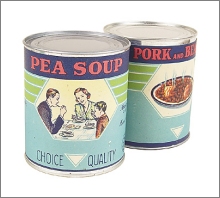
canned pea soup

Canned goods have been treasured for their convenience and shelf life for nearly two centuries!

No one can deny that they're convenient, economical and handy to have on hand for a last-minute dinner, but are canned foods really safe, or ideal?

Well, many health advocates say that fresh foods are best, followed by frozen and bringing up the rear are canned goods. Why? Largely because of the heat involved in the processing, and the potential toxins in the cans themselves.

What Does High Heat do to Canned Foods?

When a food is packed into a can, it is then heated to an extreme temperature to kill all known microorganisms. There is some debate as to what extent this form of pasteurization degrades nutrients and destroys enzymes in the food, but it is known to destroy at least some.

According to the U.S. Food and Drug Administration (FDA), "The heating process during canning destroys from one-third to one-half of vitamins A and C, riboflavin, and thiamin. For every year the food is stored, canned food loses an additional 5 to 20% of these vitamins. However, the amounts of other vitamins are only slightly lower in canned food than in fresh food."

The argument for canned food proponents is that canned facilities are usually just a few miles from the point of harvest, meaning foods are canned quite quickly after being picked. Fresh foods, meanwhile, may lose nutrients as they sit in shipping warehouses and during transportation.

"Most produce will begin to lose some of its nutrients when harvested. When produce is handled properly and canned quickly after harvest, it can be more nutritious than fresh produce sold in stores," says the FDA. "When refrigerated, fresh produce will lose half or more of some of its vitamins within 1 to 2 weeks. If it's not kept chilled or preserved, nearly half of the vitamins may be lost within a few days of harvesting. For optimum nutrition, it is generally recommended that a person eat a variety of foods."

soda cans bpa

Like canned foods, soda cans also typically contain BPA in their lining.

The Known Downside to Canned Foods

Assuming that many nutrient levels in canned foods are similar to fresh ones, why might you STILL want to opt for fresh or frozen over canned? Because of Bisphenol A (BPA).

BPA is a chemical used in countless plastic food and beverage containers, including plastic bottles and also the linings of most tin cans and soda cans. Not only has BPA been linked to fertility and reproductive problems and cancer, but recently it was also linked to an increased risk of heart disease, diabetes and liver disease.

Companies began using BPA in metal can linings in the 1950s and 1960s, and now there is widespread concern that chronic exposure to low doses of the chemical is causing serious health problems.

The FDA estimates that 17 percent of the U.S. diet is composed of canned foods, yet there are currently no government safety standards limiting the amount of BPA in canned food. However, a study by the Environmental Working Group (EWG) found some concerning findings.

Keep Your Healthy Fruits and Veggies Fresh Longer!

Once you invest in fresh produce for the health of your family, protect your investment using the MiniMate Refrigerator Unit.

The MiniMate deodorizes (replacing baking soda boxes in the fridge) and kills potentially dangerous food-borne bacteria. This extends the freshness and life of many foods 3 to 4 times longer!

Plus, the MiniMate:

  • Features an activated oxygen generator to eliminate odors, keep foods fresher longer and kill bacteria in your refrigerator
  • Naturally kills odors without any cover-up scents or fragrance
  • Reduces food spoilage and prevents cross-contamination of food odors
  • Breaks down pesticides and herbicides on produce
Find Out More About the MiniMate Refrigerator Unit Now! MiniMate Refrigerator Unit

The group contracted a national analytic laboratory to test 97 cans of food purchased at three major chain supermarkets in the United States. Thirty brands of food were tested, including varieties such as soda, canned tuna, peaches, pineapples, green beans, corn, infant formula and tomato and chicken noodle soups. What did they find?

  • One in 10 cans of food tested -- and one in three cans of infant formula -- contained enough BPA in a single serving to expose a woman or infant to BPA levels more than 200 times the government's traditional safe level of exposure for industrial chemicals.

  • Among the worst foods tested -- chicken soup, infant formula and ravioli -- just one to three servings of the food contained levels of BPA that caused serious adverse effects in animal tests.

  • The bulk of BPA exposure definitely comes from food," says Jovana Ruzicic, a spokesperson for the Environmental Working Group.

As an aside, many canned goods also contain additives such as MSG, artificial flavors, preservatives, salt and artificial colors.

What are Your Options for Truly Safe Food?

If you choose to limit canned foods in your diet either because of nutrient concerns or the potential of toxic BPA, there are many other options. The top tips include:

  • Choose fresh produce that's locally grown. This way the produce is just-picked and the nutrients are still at their peak. To keep your produce fresher, longer, simply put a MiniMate Refrigerator Unit in your fridge (it keeps food fresh for three to four times longer than normal!).

  • Choose glass instead of cans. Many popular canned foods, such as soup, beans, soda and more, are available in glass jars or bottles.

  • Choose frozen veggies instead of canned varieties. They're just as convenient, without the plastic tin-can linings.

  • If you do buy canned foods, try to buy organic varieties and always read labels. Watch out for excess amounts of salt, sugar, corn syrup or any artificial ingredients and preservatives.

Recommended Reading

Warning: Diabetes, Liver, and Heart Disease Linked to Everyday Plastics What's Your Exposure Level?!

12 Dangerous Food Additives: The Dirty Dozen Food Additives You Really Need to be Aware Of


Sources

Environmental Working Group March 5, 2007

FDA/CFSAN Food Safety A to Z Reference Guide

Mealtime.org

Related Posts with Thumbnails