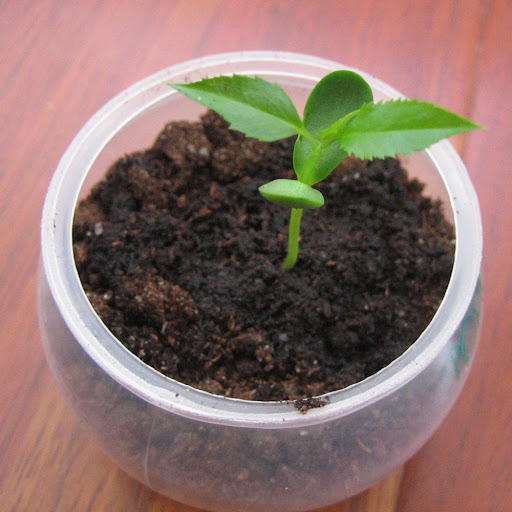
http://berenguel.blogspot.com/2009/06/lemon-seed-germination.html
Showing posts with label giy: trees. Show all posts
Sunday, January 3, 2010
GIY: Grow your own lemon trees FROM SEED!
http://berenguel.blogspot.com/2009/06/lemon-seed-germination.html
Germinate your own apple trees from seed!! :)
Read how to do it - apple seed germination!
http://berenguel.blogspot.com/2008/07/apple-seed-germination.html
Sunday, June 14, 2009
Invest in trees and soil, not just cleaner coal: U.N.
by Gerard Wynn
Fri Jun 5, 2009
LONDON (Reuters) - Chopping down fewer trees and caring for the soil may be cheaper and more effective in fighting climate change than curbing emissions from coal plants, the United Nations Environment Programme (UNEP) said on Friday.
Many energy companies and analysts say the world should invest in technology which traps carbon emissions from the flue gas of coal plants and then buries it underground.
But the technology is untested. And according to a UNEP report, there are better natural ways to store carbon.
Trees store the greenhouse gas carbon dioxide (CO2) as they grow, while soil traps carbon in the organic matter of roots and tiny organisms underground.
"Tens of billions of dollars are being earmarked for carbon capture and storage at power stations, with the CO2 to be buried underground or under the sea," said Achim Steiner, UNEP Executive Director, in the report "The Natural Fix? The Role of Ecosystems in Climate Mitigation."
"The Earth's living systems might be capable of sequestering more than 50 gigatonnes (billion tonnes) of carbon over the coming decades with the right market signals," he added.
The world pumped into the atmosphere 8.5 billion tonnes of carbon from burning fossil fuels in 2007.
Global greenhouse gas emissions are increasing at about 3 percent a year and must start falling within a decade to avoid the worst effects of climate change, scientists say. Recession will only slow annual increases temporarily, say analysts.
To read the full article:
http://in.reuters.com/article/environmentNews/idINTRE55406O20090605?sp=true
by Gerard Wynn
Fri Jun 5, 2009
LONDON (Reuters) - Chopping down fewer trees and caring for the soil may be cheaper and more effective in fighting climate change than curbing emissions from coal plants, the United Nations Environment Programme (UNEP) said on Friday.
Many energy companies and analysts say the world should invest in technology which traps carbon emissions from the flue gas of coal plants and then buries it underground.
But the technology is untested. And according to a UNEP report, there are better natural ways to store carbon.
Trees store the greenhouse gas carbon dioxide (CO2) as they grow, while soil traps carbon in the organic matter of roots and tiny organisms underground.
"Tens of billions of dollars are being earmarked for carbon capture and storage at power stations, with the CO2 to be buried underground or under the sea," said Achim Steiner, UNEP Executive Director, in the report "The Natural Fix? The Role of Ecosystems in Climate Mitigation."
"The Earth's living systems might be capable of sequestering more than 50 gigatonnes (billion tonnes) of carbon over the coming decades with the right market signals," he added.
The world pumped into the atmosphere 8.5 billion tonnes of carbon from burning fossil fuels in 2007.
Global greenhouse gas emissions are increasing at about 3 percent a year and must start falling within a decade to avoid the worst effects of climate change, scientists say. Recession will only slow annual increases temporarily, say analysts.
To read the full article:
http://in.reuters.com/article/environmentNews/idINTRE55406O20090605?sp=true
Sunday, May 3, 2009
Trees: Planting & Pruning
by Diana Greenwood Mead
February 3, 2009
http://www.supermarketguru.com/index.cfm/go/sg.viewArticle/articleId/271
For the past few weeks I have enjoyed writing about the pleasures of home grown food – from first thoughts about a few salads and a pot or two of tomatoes, to the more serious commitments of fruit bushes and vines. I think it’s time to talk about the friends that will be with you for a long time – the fruiting trees.
Apples, pears, plums, apricots, peaches, figs, nectarines, bananas, walnuts, pecans, oranges & lemons – the list is endless (as is the delight of fruit, sweet from your own tree) and depending where you live, the right varieties can be easily found at specialist nurseries, often with detailed instructions for their planting and care.
There are some fruit tree varieties (particularly apples, pears and peaches) that have been bred to remain small, and while these won’t necessarily provide you with a full supply of fruit, the fact that they can be grown in containers adds to their charms.
Fruit trees, once they have reached fruiting size, benefit from pruning (trimming) to keep them in a good useful shape and to maximise the quantity of fruit which can be harvested.
Detailed information on how to prune various trees is very complex, but it’s based on common sense - keeping the trees in a nice shape to stand up to wind and weather, cutting off branches that cross others and could rub bark off allowing disease to get into the tree, cutting out overcrowded branches and so on.
The best way to learn how to do this is probably from a book or on the web – there’s a wealth of information at www.tree-pruning.com.
To read the full article: http://www.supermarketguru.com/index.cfm/go/sg.viewArticle/articleId/271
by Diana Greenwood Mead
February 3, 2009
http://www.supermarketguru.com/index.cfm/go/sg.viewArticle/articleId/271
For the past few weeks I have enjoyed writing about the pleasures of home grown food – from first thoughts about a few salads and a pot or two of tomatoes, to the more serious commitments of fruit bushes and vines. I think it’s time to talk about the friends that will be with you for a long time – the fruiting trees.
Apples, pears, plums, apricots, peaches, figs, nectarines, bananas, walnuts, pecans, oranges & lemons – the list is endless (as is the delight of fruit, sweet from your own tree) and depending where you live, the right varieties can be easily found at specialist nurseries, often with detailed instructions for their planting and care.
There are some fruit tree varieties (particularly apples, pears and peaches) that have been bred to remain small, and while these won’t necessarily provide you with a full supply of fruit, the fact that they can be grown in containers adds to their charms.
Fruit trees, once they have reached fruiting size, benefit from pruning (trimming) to keep them in a good useful shape and to maximise the quantity of fruit which can be harvested.
Detailed information on how to prune various trees is very complex, but it’s based on common sense - keeping the trees in a nice shape to stand up to wind and weather, cutting off branches that cross others and could rub bark off allowing disease to get into the tree, cutting out overcrowded branches and so on.
The best way to learn how to do this is probably from a book or on the web – there’s a wealth of information at www.tree-pruning.com.
To read the full article: http://www.supermarketguru.com/index.cfm/go/sg.viewArticle/articleId/271
Wednesday, October 15, 2008
Trees for Organic Gardens
By Guy Sternberg
source: http://www.organicgardening.com/feature/0,7518,s1-4-76-983,00.html
Planting a tree can be a deeply satisfying act, a commitment to the future of the place where it will grow. Choose a tree that's native to the region, and your rewards multiply.
Natives are likely to thrive in your conditions with minimal attention after the first two or three years. They provide the food and shelter local wildlife depends on. And you needn't worry about introducing an invasive species like the Russian olive (Elaeagnus angustifolia).
Many natives are trees you're already familiar with. The following six genera, or groups, of North American native trees include a variety of species for different conditions; have interesting foliage, flowers, and bark; and become more beautiful with every passing year.
When thinking about a tree to plant, consider that hundreds of the finest shade and ornamental species evolved right here in North America. They have survived thousands of years of climate extremes, they have reached equilibrium with their environment, and most of them learned long ago how to cope with native pests or they would not still be here. This is truly organic!
MAPLES (Acer)
Features: The brilliant autumn color of our native sugar maple is the gold standard by which all other fall foliage is measured. Luckily, this snow-loving species shares its best attributes with maples in warmer, drier climates. In fact, native maples have adapted to nearly every soil type and watering requirement in North America. For example, the canyon maple in the southwest tolerates dry soil and, along with the more cold-hardy black maple, high pH.
Choices: Maples are naturally found in the Deep South (Florida maple), the southeastern mountains (chalk maple), and exposed midwestern sites (black maple). When you add in our other maple species, these trees comprise one of the most diverse and colorful of all tree genera, with more than 100 species thriving throughout most of the northern hemisphere. Every yard should have at least one native maple.
BIRCHES (Betula)
Features: For many people, the appeal of a birch tree lies in its glowing white bark. Our native birch species have bark that ranges in color from white to rosy brown to a shiny steel gray and exfoliates from the trunk in strips and swirls. Native birches are much better adapted to North America's more stressful climates than imports. A birch under stress, especially from heat or drought, invites a beetle that bores into the wood and eventually kills the tree. And this is particularly a problem for the nonnative birches, which haven't evolved to cope with this insect.
Uses: All birches tolerate wet soils, and most prefer them. The paper birch is among the most winter-hardy of all deciduous trees. Although not especially long-lived as trees go, with adequate moisture and sunlight, and freedom from weed competition, birches can grow very rapidly into highly ornamental shade trees that live for 30 to 40 years.
SUMACS (Rhus)
Features: Sumacs suffer from a bad reputation. Most sumac species clump from their roots, forming thickets that many people perceive as being weedy. This tendency is an adaptation to their natural environment, where they must compete for a space in the sun following fires or other calamities. (This is an advantage, however, if you want a dramatic grouping of a single species.) Worse, many people cannot say sumac without the preface poison (referring to the sap reaction, phytodermatitis, that many people have), yet we have only one toxic species, albeit a very colorful one, and you are unlikely ever to see it unless you wade into its swampy natural habitat. Sumacs are small, often shrubby, and therefore capable of embellishing the tiniest backyards with the most brilliant fall color imaginable.
Uses: Their winter form is artistic, and their flowers and fruits can be striking and long-lasting. Sumacs bring nothing but pleasure in the home garden and are among the easiest of all small trees to grow.
OAKS (Quercus)
Features: The noble oak is generally acclaimed as the national tree of the United States. Tall, stately, and sheltering, oaks can live for centuries. As they are an indispensable source of food and cover for many insects, animals, and birds, planting them invites a diversity of wildlife to your yard. Oak wood is strong and stands up to stormy weather. Thick, leathery leaves filter summer sunlight, making oaks effective shade trees, as well. An old adage says that you plant an oak for your children, but that doesn't mean you will have to wait years to enjoy an oak. The chinkapin oak, for example, can grow as much as 20 feet in 10 years.
Choices: The United States and Canada claim nearly 100 native oak species, a diverse group that ranges from low shrubs to forest giants. There's one for nearly any condition. The willow oak thrives in wet soils, while the black oak likes it very dry. The silverleaf oak takes unbelievable desert heat; the bur oak readily shakes off the cold from Saskatchewan to Quebec. The live oak is evergreen; the swamp chestnut oak has great fall color.
HAWTHORNS (Crataegus)
Features: The hawthorns are some of the toughest little trees in the tree business. Native hawthorns have white or pale yellow flowers in spring, some (Washington hawthorn, in particular) have vivid red color in fall, and almost all get to be only about 30 feet in height. The sweeping branches of the cockspur hawthorn are revealed once winter arrives, and the bright fruits of the green hawthorn make a splendid display until they finally drop or are taken by birds.
Uses: Most species have thorns, so take care to place them where you won't run into them. The thorns, on the other hand, make them desirable habitat for the nesting birds that add so much pleasure to gardening. Hawthorns are in the rose family, along with crabapples, a closely related species to which they bear a resemblance. Hawthorn fruits are edible and taste much like crabapples. Some, such as mayhaw fruits, are made into jelly or wine.
PINES (Pinus)
Features: The scent of pine stands for purity and freshness, or so you'd think from looking at the labels of cleansers and air fresheners. But there's more to appreciate about pine trees than that lab-created imitation aroma. They'll grow in the poorest possible soil, which means you're sure to find one that will take to your land, be it dense clay or porous sand. Most pines are unimpeded by drought; loblolly pine, among others, tolerates wet soil as well. Frequent partners to oaks in the wild, pines have adapted to the coldest and hottest of climates.
Choices: You'll have no trouble finding a pine that suits your garden's size, either. Ponderosa pine and eastern white pine, for instance, reach regal heights, growing up to 100 feet tall, where their aromatic needles sing in the wind. Don't have space for a skyscraping tree? Shore pine and piƱon pine top out at a more manageable 20 to 30 feet.
source: http://www.organicgardening.com/feature/0,7518,s1-4-76-983,00.html
Planting a tree can be a deeply satisfying act, a commitment to the future of the place where it will grow. Choose a tree that's native to the region, and your rewards multiply.
Natives are likely to thrive in your conditions with minimal attention after the first two or three years. They provide the food and shelter local wildlife depends on. And you needn't worry about introducing an invasive species like the Russian olive (Elaeagnus angustifolia).
Many natives are trees you're already familiar with. The following six genera, or groups, of North American native trees include a variety of species for different conditions; have interesting foliage, flowers, and bark; and become more beautiful with every passing year.
When thinking about a tree to plant, consider that hundreds of the finest shade and ornamental species evolved right here in North America. They have survived thousands of years of climate extremes, they have reached equilibrium with their environment, and most of them learned long ago how to cope with native pests or they would not still be here. This is truly organic!
MAPLES (Acer)
Features: The brilliant autumn color of our native sugar maple is the gold standard by which all other fall foliage is measured. Luckily, this snow-loving species shares its best attributes with maples in warmer, drier climates. In fact, native maples have adapted to nearly every soil type and watering requirement in North America. For example, the canyon maple in the southwest tolerates dry soil and, along with the more cold-hardy black maple, high pH.
Choices: Maples are naturally found in the Deep South (Florida maple), the southeastern mountains (chalk maple), and exposed midwestern sites (black maple). When you add in our other maple species, these trees comprise one of the most diverse and colorful of all tree genera, with more than 100 species thriving throughout most of the northern hemisphere. Every yard should have at least one native maple.
BIRCHES (Betula)
Features: For many people, the appeal of a birch tree lies in its glowing white bark. Our native birch species have bark that ranges in color from white to rosy brown to a shiny steel gray and exfoliates from the trunk in strips and swirls. Native birches are much better adapted to North America's more stressful climates than imports. A birch under stress, especially from heat or drought, invites a beetle that bores into the wood and eventually kills the tree. And this is particularly a problem for the nonnative birches, which haven't evolved to cope with this insect.
Uses: All birches tolerate wet soils, and most prefer them. The paper birch is among the most winter-hardy of all deciduous trees. Although not especially long-lived as trees go, with adequate moisture and sunlight, and freedom from weed competition, birches can grow very rapidly into highly ornamental shade trees that live for 30 to 40 years.
SUMACS (Rhus)
Features: Sumacs suffer from a bad reputation. Most sumac species clump from their roots, forming thickets that many people perceive as being weedy. This tendency is an adaptation to their natural environment, where they must compete for a space in the sun following fires or other calamities. (This is an advantage, however, if you want a dramatic grouping of a single species.) Worse, many people cannot say sumac without the preface poison (referring to the sap reaction, phytodermatitis, that many people have), yet we have only one toxic species, albeit a very colorful one, and you are unlikely ever to see it unless you wade into its swampy natural habitat. Sumacs are small, often shrubby, and therefore capable of embellishing the tiniest backyards with the most brilliant fall color imaginable.
Uses: Their winter form is artistic, and their flowers and fruits can be striking and long-lasting. Sumacs bring nothing but pleasure in the home garden and are among the easiest of all small trees to grow.
OAKS (Quercus)
Features: The noble oak is generally acclaimed as the national tree of the United States. Tall, stately, and sheltering, oaks can live for centuries. As they are an indispensable source of food and cover for many insects, animals, and birds, planting them invites a diversity of wildlife to your yard. Oak wood is strong and stands up to stormy weather. Thick, leathery leaves filter summer sunlight, making oaks effective shade trees, as well. An old adage says that you plant an oak for your children, but that doesn't mean you will have to wait years to enjoy an oak. The chinkapin oak, for example, can grow as much as 20 feet in 10 years.
Choices: The United States and Canada claim nearly 100 native oak species, a diverse group that ranges from low shrubs to forest giants. There's one for nearly any condition. The willow oak thrives in wet soils, while the black oak likes it very dry. The silverleaf oak takes unbelievable desert heat; the bur oak readily shakes off the cold from Saskatchewan to Quebec. The live oak is evergreen; the swamp chestnut oak has great fall color.
HAWTHORNS (Crataegus)
Features: The hawthorns are some of the toughest little trees in the tree business. Native hawthorns have white or pale yellow flowers in spring, some (Washington hawthorn, in particular) have vivid red color in fall, and almost all get to be only about 30 feet in height. The sweeping branches of the cockspur hawthorn are revealed once winter arrives, and the bright fruits of the green hawthorn make a splendid display until they finally drop or are taken by birds.
Uses: Most species have thorns, so take care to place them where you won't run into them. The thorns, on the other hand, make them desirable habitat for the nesting birds that add so much pleasure to gardening. Hawthorns are in the rose family, along with crabapples, a closely related species to which they bear a resemblance. Hawthorn fruits are edible and taste much like crabapples. Some, such as mayhaw fruits, are made into jelly or wine.
PINES (Pinus)
Features: The scent of pine stands for purity and freshness, or so you'd think from looking at the labels of cleansers and air fresheners. But there's more to appreciate about pine trees than that lab-created imitation aroma. They'll grow in the poorest possible soil, which means you're sure to find one that will take to your land, be it dense clay or porous sand. Most pines are unimpeded by drought; loblolly pine, among others, tolerates wet soil as well. Frequent partners to oaks in the wild, pines have adapted to the coldest and hottest of climates.
Choices: You'll have no trouble finding a pine that suits your garden's size, either. Ponderosa pine and eastern white pine, for instance, reach regal heights, growing up to 100 feet tall, where their aromatic needles sing in the wind. Don't have space for a skyscraping tree? Shore pine and piƱon pine top out at a more manageable 20 to 30 feet.
Labels:
giy,
giy: organic garden,
giy: trees
Planting Trees For Long Lives
A scientist shares her discoveries about successful transplanting.
By Linda Chalker-Scott
In This Article
> 8 Steps to Healthier Trees
Related Articles
> Tree Buying Guide
> Trees & Shrubs--10 Great Varieties
> Trees for Organic Gardens
> Trees Save Energy
> Regional Guide to Native Trees
There's a dirty little secret in our landscapes: Seemingly healthy trees and shrubs are experiencing preventable neglect and early death. Within 10 years of installation, specimens that once seemed to thrive suddenly develop diseases of the crown and other disorders, eventually failing. The average life span of trees in urban areas can be in the single digits, rather than in the decades or centuries typical to tree species.
Through research and practice, I have uncovered one problem that can go unnoticed at the time of planting: poor root structure (or inadequate root preparation). Roots grow normally until forced into an unnatural shape. Contain- ers are often narrow and deep, not the best shape for the broad, relatively shallow root system of a tree. Nevertheless, roots will follow the shape forced upon them and unless freed from this arrange- ment will continue to grow as misshapen masses until they can no longer supply water or otherwise support the tree. This problem must be corrected during trans- planting; it is not enough to just remove the pot.
The city of Spokane, Washington, experienced heavy loss of new trees until 12 years ago, when it adopted the techniques described here. Since then, 97 percent of the trees planted have survived the hot, dry summers.
Be forewarned: Many nurseries will not guarantee their plant materials if the customer disturbs the rootball. However, the benefits associated with preparing and correcting roots far outweigh the risks.
Correct problem roots before they become fatal. Potbound plants exhibit circling root systems that if not corrected become girdling roots, which can lead to the early death of otherwise healthy trees and shrubs. At transplant time, an aggressive approach to root preparation can uncover potentially fatal root flaws. Circling, J-hooked, knotted, and other misshapen roots can often be corrected by careful pruning.
Encourage the growth of new roots.
Counterintuitive as it may seem, pruning induces new root growth. Once the plant is installed, new, flexible roots will begin growing immediately from tissue behind the cuts. These new roots, with their associated root hairs, are the absorbent roots and will begin to reestablish adequate water flow to the rest of the plant.
Remove materials that have no business in your landscape.
Wire baskets, burlap, and twine all can interfere with normal root growth and slow or prevent establishment. There is no good reason to leave this material in a planting hole.
Promote the movement of air, water, and roots.
The loose, soilless planting medium used to grow trees in containers provides too high a contrast with the denser soil surrounding the planting hole, deterring water (and therefore roots) from spreading beyond the hole. Remove as much of this planting mix as possible before the plant is installed. Similarly, when balled-and-burlapped trees are planted into the landscape, the differences between soil textures will inhibit root establishment. Removal of the soil in the rootball prevents this and also reduces the weight of the tree, making it easier to handle and install.
Trees Are Cool
According to the USDA, the cooling effect of a healthy tree is equal to 10 room-size air-conditioners operating 20 hours a day. Planting trees in our cities will absorb 33 million tons of CO2 every year and save $4 billion in energy costs, says the National Wildlife Federation.
By Linda Chalker-Scott
In This Article
> 8 Steps to Healthier Trees
Related Articles
> Tree Buying Guide
> Trees & Shrubs--10 Great Varieties
> Trees for Organic Gardens
> Trees Save Energy
> Regional Guide to Native Trees
8 Steps to Healthier Trees
1. Using a hose or a water bath, remove all soil from the roots. Work out clumps of soil from between the roots using your fingers. Let rootballs soak for several hours if they are too dry to work.
2. Prune excessively long and defective roots. From this point on, roots must be kept submerged or wrapped in wet cloth.
3. Dig a shallow hole only as deep as the root system and at least twice as wide. In the center, form a soil mound to support the root crown.
4. Arrange the roots radially over the mound and backfill with the same soil that came out of the hole. Do not use any type of soil amendment.
5. Water well, using the water from Step 1, which will contain nutrients and microbes. Add more soil as holes develop, and gently firm the soil.
6. Mulch all disturbed soil with 4 inches of coarse organic mulch, keeping it a few inches away from the trunk. (Think "doughnut," not "volcano.")
7. Water your tree well during the first year of establishment. You have removed a good portion of the root system and its ability to take up water, and nutrients will be temporarily impaired.
8. Keep it simple and natural: Do not prune the top of the tree or add expensive but pointless transplant supplements.
By Linda Chalker-Scott
In This Article
> 8 Steps to Healthier Trees
Related Articles
> Tree Buying Guide
> Trees & Shrubs--10 Great Varieties
> Trees for Organic Gardens
> Trees Save Energy
> Regional Guide to Native Trees
There's a dirty little secret in our landscapes: Seemingly healthy trees and shrubs are experiencing preventable neglect and early death. Within 10 years of installation, specimens that once seemed to thrive suddenly develop diseases of the crown and other disorders, eventually failing. The average life span of trees in urban areas can be in the single digits, rather than in the decades or centuries typical to tree species.
Through research and practice, I have uncovered one problem that can go unnoticed at the time of planting: poor root structure (or inadequate root preparation). Roots grow normally until forced into an unnatural shape. Contain- ers are often narrow and deep, not the best shape for the broad, relatively shallow root system of a tree. Nevertheless, roots will follow the shape forced upon them and unless freed from this arrange- ment will continue to grow as misshapen masses until they can no longer supply water or otherwise support the tree. This problem must be corrected during trans- planting; it is not enough to just remove the pot.
The city of Spokane, Washington, experienced heavy loss of new trees until 12 years ago, when it adopted the techniques described here. Since then, 97 percent of the trees planted have survived the hot, dry summers.
Be forewarned: Many nurseries will not guarantee their plant materials if the customer disturbs the rootball. However, the benefits associated with preparing and correcting roots far outweigh the risks.
Correct problem roots before they become fatal. Potbound plants exhibit circling root systems that if not corrected become girdling roots, which can lead to the early death of otherwise healthy trees and shrubs. At transplant time, an aggressive approach to root preparation can uncover potentially fatal root flaws. Circling, J-hooked, knotted, and other misshapen roots can often be corrected by careful pruning.
Encourage the growth of new roots.
Counterintuitive as it may seem, pruning induces new root growth. Once the plant is installed, new, flexible roots will begin growing immediately from tissue behind the cuts. These new roots, with their associated root hairs, are the absorbent roots and will begin to reestablish adequate water flow to the rest of the plant.
Remove materials that have no business in your landscape.
Wire baskets, burlap, and twine all can interfere with normal root growth and slow or prevent establishment. There is no good reason to leave this material in a planting hole.
Promote the movement of air, water, and roots.
The loose, soilless planting medium used to grow trees in containers provides too high a contrast with the denser soil surrounding the planting hole, deterring water (and therefore roots) from spreading beyond the hole. Remove as much of this planting mix as possible before the plant is installed. Similarly, when balled-and-burlapped trees are planted into the landscape, the differences between soil textures will inhibit root establishment. Removal of the soil in the rootball prevents this and also reduces the weight of the tree, making it easier to handle and install.
Trees Are Cool
According to the USDA, the cooling effect of a healthy tree is equal to 10 room-size air-conditioners operating 20 hours a day. Planting trees in our cities will absorb 33 million tons of CO2 every year and save $4 billion in energy costs, says the National Wildlife Federation.
By Linda Chalker-Scott
In This Article
> 8 Steps to Healthier Trees
Related Articles
> Tree Buying Guide
> Trees & Shrubs--10 Great Varieties
> Trees for Organic Gardens
> Trees Save Energy
> Regional Guide to Native Trees
8 Steps to Healthier Trees
1. Using a hose or a water bath, remove all soil from the roots. Work out clumps of soil from between the roots using your fingers. Let rootballs soak for several hours if they are too dry to work.
2. Prune excessively long and defective roots. From this point on, roots must be kept submerged or wrapped in wet cloth.
3. Dig a shallow hole only as deep as the root system and at least twice as wide. In the center, form a soil mound to support the root crown.
4. Arrange the roots radially over the mound and backfill with the same soil that came out of the hole. Do not use any type of soil amendment.
5. Water well, using the water from Step 1, which will contain nutrients and microbes. Add more soil as holes develop, and gently firm the soil.
6. Mulch all disturbed soil with 4 inches of coarse organic mulch, keeping it a few inches away from the trunk. (Think "doughnut," not "volcano.")
7. Water your tree well during the first year of establishment. You have removed a good portion of the root system and its ability to take up water, and nutrients will be temporarily impaired.
8. Keep it simple and natural: Do not prune the top of the tree or add expensive but pointless transplant supplements.
Labels:
giy,
giy: planting trees,
giy: pruning,
giy: trees
Subscribe to:
Posts (Atom)